The 28-day notice
Under FIDIC 1999 Sub-Clause 20.1 and FIDIC 2017 Sub-Clause 20.2.1, the Contractor must give notice within 28 days of becoming aware of the event. Miss it, and an otherwise valid claim can fail.
Under FIDIC, a claim notice that arrives late can cost the whole entitlement. BuildCore registers every contractual letter with its time bar and response deadline, highlights the ones running out, and — when you ask — has AI classify the letter, point to the clause and suggest actions. Claims then move from notice to the Engineer's determination against their own clocks, with a full audit trail.
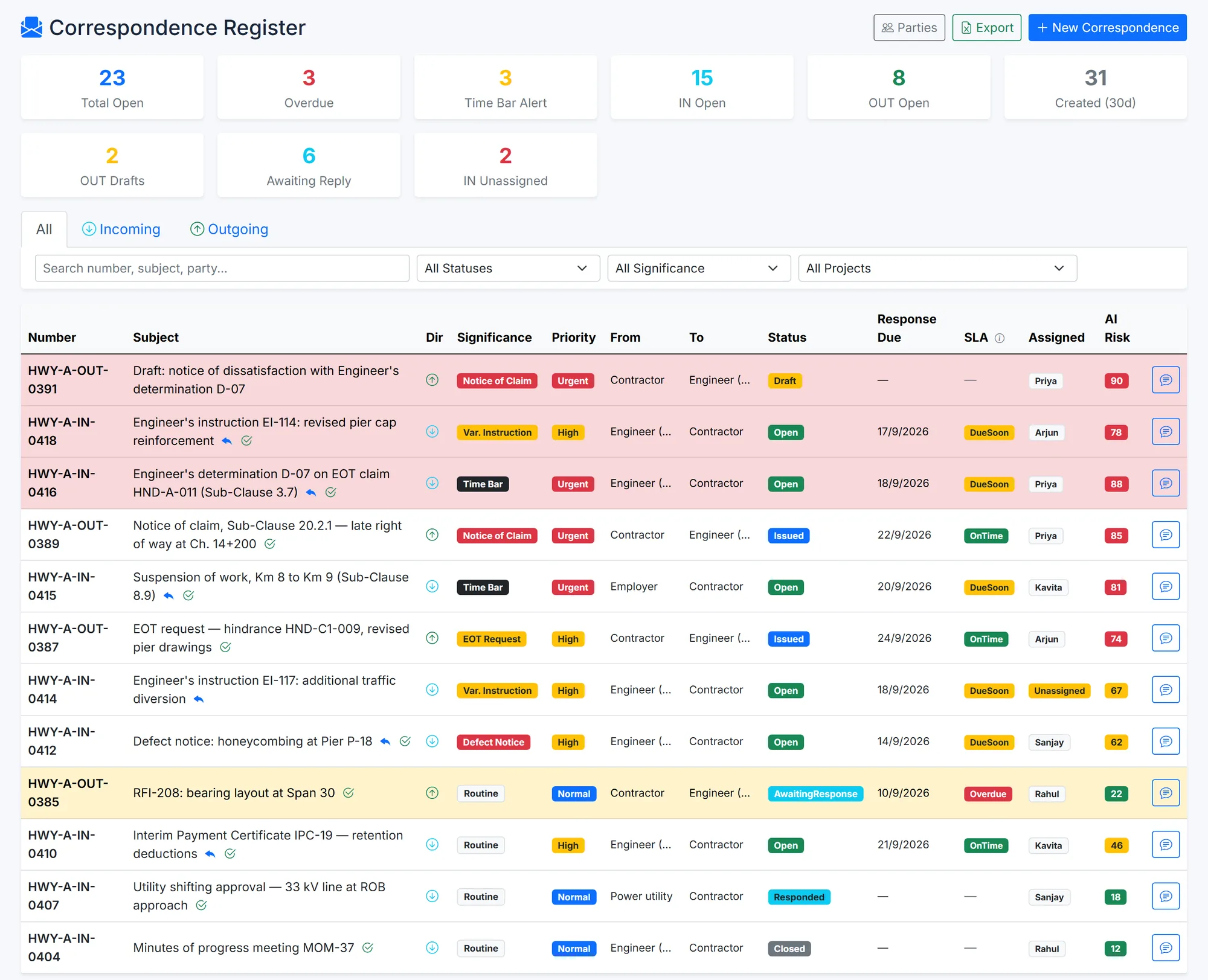
Most commercial teams know the contract. What they lack is a system that notices the letter that started a clock, and keeps counting when everyone is busy on site.
Under FIDIC 1999 Sub-Clause 20.1 and FIDIC 2017 Sub-Clause 20.2.1, the Contractor must give notice within 28 days of becoming aware of the event. Miss it, and an otherwise valid claim can fail.
The fully detailed claim follows — within 42 days under the 1999 edition, 84 days under 2017 (Sub-Clause 20.2.4) — and interim updates continue while the effect lasts.
The Engineer has deadlines too — including 42 days to agree and a further 42 to determine under the 2017 Sub-Clause 3.7. Those are leverage, if someone is tracking them.
AI assists when you ask it to. People decide.
Registered as a contractual notice, with its time bar and response deadline.
On request: notice of claim, EOT request, variation instruction, defect notice, time-bar letter, dispute…
AI points to the likely clause and time bar; your team confirms the deadline.
Suggested actions, each with a deadline, a role and a priority, for your team to act on.
AI drafts the response for the commercial team to review and issue.
Notice, detailed claim and determination — each against its own clock.
The correspondence register records whether a letter is a contractual notice, its time bar and its response deadline, and highlights any time bar inside seven days. Run AI analysis on a letter and it returns:
Each project is set up with its FIDIC edition and its notice, detailed-claim and Engineer's-determination periods (every step and date is in our Clause 20 claims checklist). Then every claim carries:
Contract correspondence is sensitive. BuildCore lets each organisation decide where it is processed.
Run the AI on a local model through Ollama, and letters never leave your network — the right choice for government bodies and on-premise deployments.
Use OpenAI, Anthropic or Google Gemini under your own agreement. External AI processing only switches on once it has been enabled for your organisation.
A hindrance register with preset clocks for FIDIC 1999 and 2017, NEC4 and India's NHAI, CPWD and Railways contracts, letters and an evidence pack.
Client contracts, payment milestones, variation orders, EOT requests and FIDIC claims against their Clause 20 time bars.
Budgets, commitments and interim payment certificates, on the same record as the claims.
Each project records its FIDIC edition and its notice, detailed-claim and Engineer's-determination periods. The Hindrance & EOT module ships presets for the 1999 and 2017 conditions, and every period can be edited to match the particular conditions of the contract.
No. When a user runs it, the AI classifies a letter, points to the likely clause and time bar, scores the risk, suggests actions and drafts a reply. Nothing is sent or changed on its say-so: your commercial team reviews and decides, and the Engineer determines under the contract.
Yes. BuildCore can use a local model through Ollama running on your own server. Cloud providers — OpenAI, Anthropic, Google Gemini — are optional and only process data once enabled for your organisation.
Yes. The Hindrance & EOT module has presets for NEC4 and for India's NHAI EPC and HAM, CPWD GCC 2023 and Indian Railways GCC 2022 contracts, plus a custom regime where every clock can be set.
We will set up its clocks, run a real letter through the AI, and show you the claim register the way your commercial team would use it.